
Palo Pinto County Release Meanings
A name leaving the Palo Pinto County Jail roster does not, by itself, mean that the person entered the community. The departure might follow an accepted bond, dismissal, release order, time served, sentence completion, or another court-authorized event. It can also reflect a transfer to the Texas Department of Criminal Justice, another county, the U.S. Marshals Service, or immigration custody. A hospital move, data correction, or system delay can create the same visible result.
The key distinction is custody movement. A transfer means one agency handed the person to another. Parole ends confinement in a state prison but starts supervised service of the sentence in the community. Mandatory supervision is another form of supervised TDCJ release. Probation, called community supervision in Texas records, is imposed through a court and may occur instead of prison. A flat discharge normally means that the sentence ended.
- Time served
- A court-authorized end to local confinement based on time already credited.
- Detainer
- A request or authority that may cause another agency to take custody.
- Discharge
- Completion of the sentence or supervision status recorded by the responsible agency.
- Expunction
- A court-controlled process that restricts release and maintenance of qualifying records.
Palo Pinto County Release Paths
The record source changes with the kind of departure. County jail staff create booking-out and release or transfer entries. Courts create the orders and judgments that explain legal authority. TDCJ keeps state-prison release, parole, mandatory-supervision, and discharge data. Federal and immigration agencies maintain separate systems.
| Departure | Meaning | Best confirmation |
|---|---|---|
| Bond or court release | Local custody processing ended under legal authority | Sheriff booking-out entry and bond or release order |
| Time served or sentence end | Eligible county confinement was completed | Release entry plus signed judgment and jail-credit record |
| TDCJ transfer | State custody began elsewhere | TDCJ result and county transfer record |
| Parole or mandatory supervision | Prison confinement ended while state supervision continued | TDCJ actual release status and parole record |
| Federal or ICE transfer | Another sovereign took custody | Transfer record, federal case, BOP or ICE locator as applicable |
Can a missing roster name prove release? No. It is one clue. The booking-out or transfer entry supplies the event, and the court or destination record helps explain it.
Note: Death or escape can also remove a name from an active list and must never be described as a release.
Palo Pinto County Release Record Fields
A focused request should identify one booking and ask for existing documents. The sheriff form does not promise every field, yet precise wording helps the records officer locate the booking-in/out sheet and release or transfer order. Protected data can be removed before disclosure.
| Field | What it shows |
|---|---|
| Full name and identifiers | Connects the record to the correct person and booking |
| Booking or arrest number | Separates one custody event from another |
| Booking date and time | Marks the start of the recorded jail stay |
| Release date and time | Marks when local custody processing ended |
| Release type or authority | Identifies bond, order, sentence completion, transfer, or another basis |
| Receiving agency | Shows the destination when the event was a transfer |
| Bond and surety data | Documents applicable bond activity without proving release by itself |
| Booking photograph | Links the photo to that booking, subject to current access law |
The court file answers a related but distinct question. It may contain the cause number, bond order, dismissal, judgment, sentence, jail credit, probation order, revocation, or discharge. A court order can establish why custody should end, while the jail entry records when staff processed the physical departure.
Request Palo Pinto Release Records
Use the Palo Pinto County Sheriff's public-information form. Choose Other for a release or transfer record and Mugshot for a booking photograph. The form asks for requester contact details, the involved location, the person's name, and a specific incident date. A case or service number and clear additional detail can narrow the search.
- Identify the full name, approximate booking or arrest date, and case or service number if known.
- Ask for the booking-in/out sheet and the release or transfer order tied to that booking.
- Specify the release or transfer date and time, authority, type, and receiving agency when recorded.
- Request electronic copies and allow redaction of confidential fields. Name the mugshot separately if it is needed.
- Compare the response with the signed court order or destination-system record.
A concise request asks for records, not for staff to answer questions or create a new report. The county form publishes no local fee or promised turnaround. Under the Texas Public Information Act, public information must be produced promptly or handled through the statutory notice and ruling process. If an Attorney General ruling is sought, the governmental body generally has ten business days to request it.
The official form visibly separates “Mugshot” and “Other” request types.
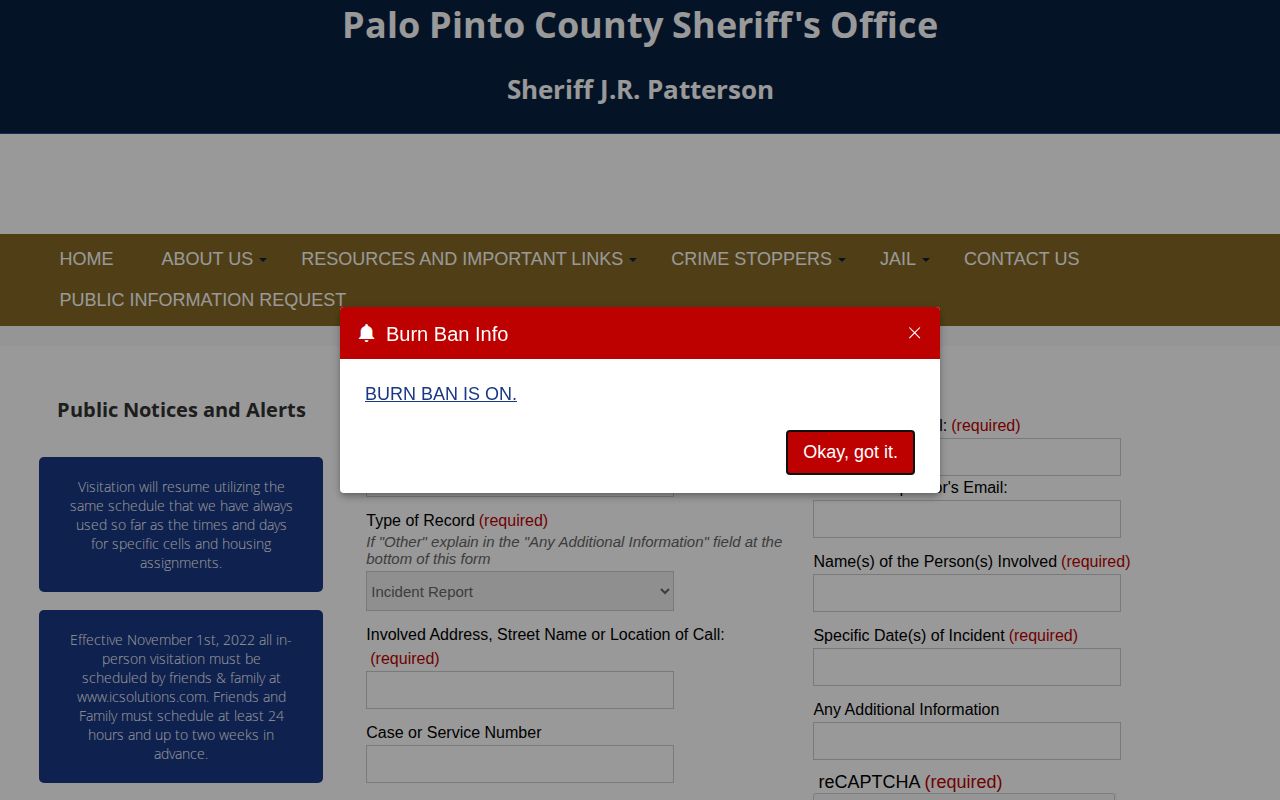
That separation is useful when asking for both the durable release entry and the photo attached to the booking.
Note: Date of birth should be supplied only when needed to distinguish people with similar names.
Palo Pinto Release Record Retention
Texas Government Code Chapter 552 creates the general public-information right, subject to law-enforcement, privacy, juvenile, victim, and other exceptions. The statewide public-safety retention schedule explains why the web roster is not the last word. A permanent jail register includes a release or transfer date. Booking-in/out sheets and commitment, transfer, and release orders have a minimum retention of release or transfer plus two years.
Since 2025, Texas expunction provisions appear in Code of Criminal Procedure Chapter 55A. Eligibility depends on the case and can include qualifying acquittal, pardon, dismissal, no-charge, or identity-theft settings. Nondisclosure under Government Code Chapter 411 differs from expunction: it limits ordinary public disclosure in qualifying cases but does not destroy the record and still permits listed agency access. Juvenile records are closed, and sealed or expunged details should not be republished.
Palo Pinto Release Court Trail
Palo Pinto County's court trail splits by court level. County and misdemeanor matters go through the County Clerk and its Tyler access route. Felony and district matters go through the District Clerk, with a separate District Attorney case index as another locator. This split matters after a jail name disappears because the signed order can survive long after the active roster changes.
Start with the County Clerk resources or Tyler Self-Service for available index data. The County Clerk says staff needs a case number for criminal-record work and provides public terminals at the courthouse and Mineral Wells Annex. For a felony matter, use the District Clerk record channel or the DA index, then obtain the signed judgment, dismissal, sentence, bond order, or community-supervision order.
A docket is a calendar. It does not prove that release occurred. Likewise, a probation order may authorize community supervision without stating the exact minute jail staff completed release. Pair the court document with the sheriff booking-out entry for the clearest local confirmation.
Palo Pinto Bond Release Proof
The current roster can show total bond and charge-level bond amounts. Those numbers describe conditions recorded on the custody card. They do not establish that money was paid, a surety obligation was accepted, a judge approved the release, or jail staff completed booking-out.
The sheriff also posts surety-agent forms with a warning that they are not for public use. The presence of a form is not evidence about any named person. Confirm a bond departure through the completed booking-out entry and the matching bond or release order.
The official warning can be seen on the Palo Pinto County surety forms page.
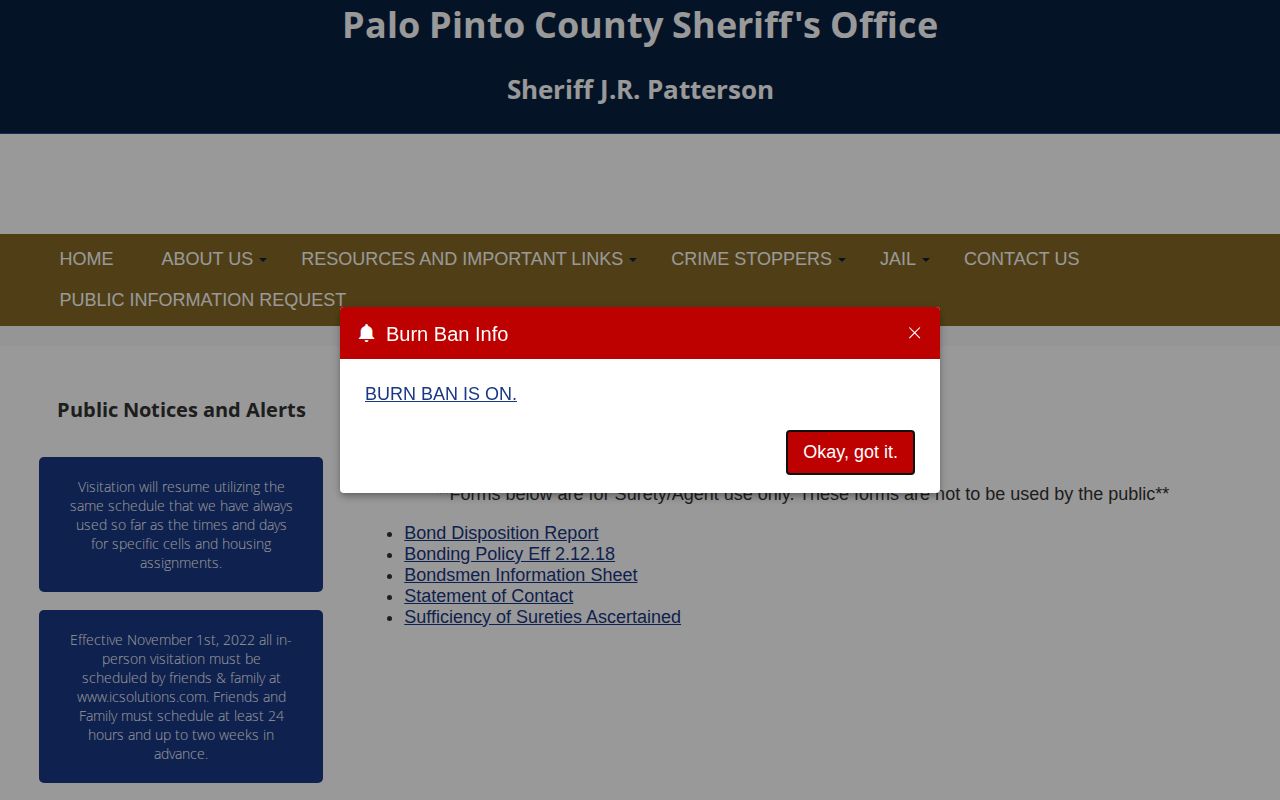
It reinforces why a displayed bond amount and an available form are clues, not completed-release proof.
Find Palo Pinto County Released Inmates
Begin with identity and the last known custody system. Full name alone can produce a false match. Use a booking number, TDCJ or SID number, date of birth, cause number, and arrest date when lawfully available. Then follow the agency trail instead of treating every database as one statewide roster.
- Search the county's Current Inmates view. Use 24 Hours Arrests and Inmates by Arrest Date only for arrest context.
- Save the arrest date, charge, warrant, and case identifiers shown for the correct person.
- If the name disappears, test likely transfer paths through TDCJ, the court file, federal case records, or ICE.
- Submit the sheriff request for the booking-out sheet and release or transfer order.
- Read the signed disposition. A docket date or roster absence is not enough.
- For state custody, separate projected, scheduled, and actual release information.
Still in county custody: look for the matched person in Current Inmates and treat the card as present-custody information. Released from the county jail: use the booking-out or release record, supported by the signed court order. Transferred to state custody: use the county transfer entry and TDCJ detail. Released from a state prison: confirm the actual TDCJ release or discharge rather than relying on a projected date.
Federal records have their own boundary. BOP can confirm departure from BOP custody for a matched federal prisoner, but a BOP release label does not rule out another hold or supervision. ICE can show a recent immigration-custody release for a limited period. Neither system replaces the Palo Pinto County record when the event being checked was a county jail departure.
The county's “24 Hours Arrests” label describes recent intake. It should not be read as a release feed or proof that a named person left custody.
Palo Pinto Jail Release Search
The official county-linked Interop jail interface offers three exact tabs: Current Inmates, 24 Hours Arrests, and Inmates by Arrest Date. It has no release tab, release date, 72-hour release window, archive, or published update schedule. A card may show a photograph or unavailable placeholder, name, sex, address, arrest date, total bond, and charge details.
The official Palo Pinto County jail interface makes the distinction visible.
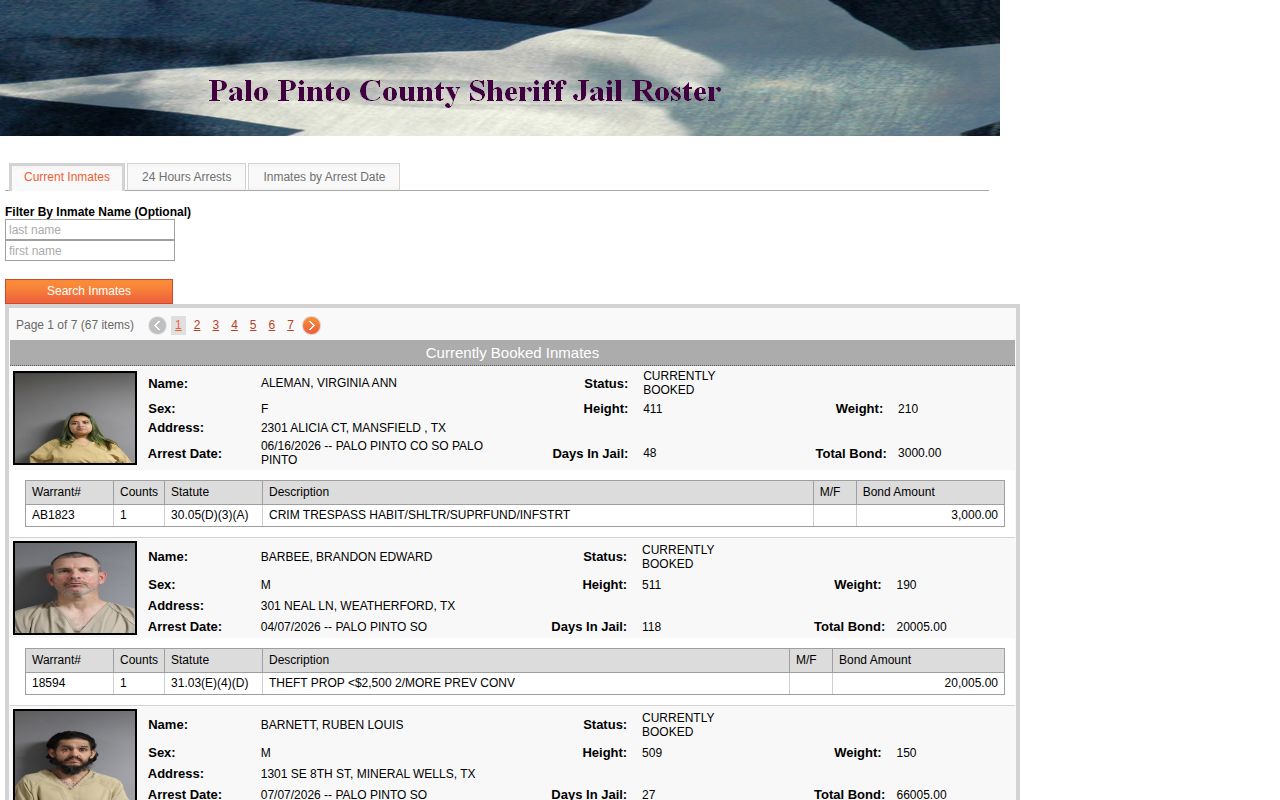
The tabs help locate a recent booking, but none supplies a release time, release reason, transfer destination, or released status.
What if the correct person is absent? Check spelling and identifiers, then search the destination systems. An absent name can reflect release, transfer, correction, or lag. Request the sheriff record when exact proof is needed.
Texas Offender Search Release Records
Use the TDCJ Inmate Information Search when a state commitment or state-prison release is plausible. A TDCJ number or SID is the strongest search key. A name search should be checked against date of birth, county of conviction, offense, sentence, and TDCJ number before relying on the result.
| Search or detail field | How to use it |
|---|---|
| TDCJ number | Use the seven-digit state identifier when known |
| SID | Use the Texas state identification number to narrow identity |
| Name | Compare spelling with other identity details |
| County of conviction | Distinguish a Palo Pinto case from a similar name |
| Projected Release Date | Treat as a calculated forecast, not completed departure |
| Scheduled date and location | Read as operational information that may still change |
| Actual release or discharge | Use as the completed state event, subject to identity match |
No TDCJ result does not prove a Palo Pinto County release. The person may never have entered state custody, the transfer may not have posted, identifiers may differ, or a historical record may require a formal request. TDCJ also accepts locator questions at pia@tdcj.texas.gov and by phone at 936-295-6371 or 800-535-0283 on weekdays from 8 a.m. to 5 p.m. The email locator provides listed information without charge but not photographs.
Note: A projected date predicts, a scheduled date guides processing, and an actual release or discharge confirms the state event.
Palo Pinto Post-Release Verification
Parole and mandatory supervision are handled by the TDCJ Parole Division after state-prison departure. Palo Pinto County cases assigned locally are served through the Mineral Wells District Parole Office. County probation is different and is managed through Palo Pinto County CSCD under the court's order. Texas has no public statewide probationer-name locator comparable to TDCJ.
Texas replaced county VINE/VINELink with Texas IVSS-Counties in 2025. Search by name or available DOC, SID, jail, or permanent-booking identifier, then confirm the correct identity. The system may offer release, transfer, custody, or court notices by text, call, or email. Palo Pinto participation should be checked live because the state warns that not every county participates.
TDCJ IVSS is a separate system for state-prison, parole, and mandatory-supervision events. An alert is useful evidence, but IVSS warns that people no longer in custody may not appear. Preserve the notice, then obtain the official release or transfer record.
Palo Pinto Release Property Records
The sheriff publishes mail, commissary, and item rules for people who are currently held, but no official release-exit, property handoff, family waiting, transport, or pickup instructions were found. Current-custody rules should not be extended into claims about the release gate. Operational questions belong with the jail, while past proof belongs in the record request.
Texas retention rules give county property inventory and return receipts a minimum of release or transfer plus two years. If a property issue matters, identify the booking and ask whether an existing return receipt is responsive. TDCJ follows a separate state-prison process. Government Code Section 501.0165 directs TDCJ to check for a valid license or identification and, when applicable, request a DPS identification card before release. That rule does not establish the Palo Pinto Jail's exit practice.
Which Releases Receive Gate Money?
Official TDCJ guidance says a person who flat-discharges from the Correctional Institutions Division receives a $100 gate check. This is a narrow state-prison fact. It does not automatically apply to someone leaving Palo Pinto County Jail, and it should not be promised for a parole release.
The rule illustrates why custody type must be settled first. A county bond release, county time-served departure, state flat discharge, parole release, and transfer are different events with different records and logistics. No verified Palo Pinto County source publishes a gate payment or local release stipend.
Palo Pinto Federal Release Lookup
A federal or immigration path applies only when the case or transfer points there. The BOP Inmate Locator searches by BOP, DCDC, FBI, or INS number, or by name with identity refinements. A past date with RELEASED or Not in BOP Custody establishes departure from BOP custody, not freedom from every jurisdiction. IN TRANSIT means movement, and a future date remains projected.
ICE's Online Detainee Locator uses an A-number and country of birth, or exact biographical data. It covers current ICE custody and releases from ICE custody during the prior 60 days. A county-to-ICE handoff is a transfer, while later departure from ICE is a separate release. The U.S. Marshals Service has no comparable public locator for federal pretrial custody, so use the federal court order and appropriate district verification.
Palo Pinto County Release Facilities
The Palo Pinto County Jail, also called the Law Enforcement Center, is the verified county detention facility. It holds people awaiting court action and eligible local sentences. A community departure is confirmed through its booking-out record and the related court authority. A transfer requires checking the receiving system.
The Mineral Wells Police Department is a municipal arrest and short-term holding channel, not a verified separate long-term jail with its own public release archive. A police arrest may end in authorized release or transfer and booking into the county jail. Use the police record, county roster, and court case rather than inventing a city-jail release database.
- Palo Pinto County Jail: county booking-out, release, and transfer records.
- Mineral Wells Police Department: arresting-agency record followed by county and court checks.