
Palo Pinto Released Mugshot Sources
A mugshot is the face photograph made as part of a booking or correctional record. Palo Pinto County's current Interop cards show either a face image or an explicit unavailable-image placeholder. The interface has no archive of photos for released people. Once a current card disappears, the same image may still exist in the sheriff's retained booking record even though it is no longer displayed online.
Texas public-information law governs a request to the sheriff, subject to law-enforcement, privacy, juvenile, victim, expunction, nondisclosure, and other limits. Access is not automatic in every case. The records custodian decides what can be released and what must be redacted or withheld under current law.
Where Palo Pinto Mugshots Appear
Choose a photo channel by custody system and record age. The county jail, TDCJ, and DPS registry are separate databases. A county booking image does not automatically move into the state offender system, and a registry photograph exists only when registration law applies.
| Channel | Photo status | Access route |
|---|---|---|
| Sheriff current roster | Photo or unavailable placeholder | Search the official Interop current card while it remains visible. |
| Sheriff release archive | No public archive found | Request the booking photo through the official sheriff form. |
| Sheriff app or social feed | None officially linked | Do not substitute an unverified app listing for the county source. |
| TDCJ | CID photograph may be available | Use a focused TDCJ public-information request; the email locator does not provide photos. |
| DPS registry | Photo for covered registrants only | Use the official registry only when a registration duty applies. |
| News coverage | Sometimes | Treat it as event context, not release or disposition proof. |
Commercial mirrors may retain stale or misidentified copies. They are not an official route and are not linked here. For a verified local image, identify the Palo Pinto booking and ask the sheriff that holds the original record.
Palo Pinto Roster Photo Limits
The official Interop screen shows the photo area beside identity, arrest, bond, and charge data. Those cards are current-arrest or current-custody records. They contain no released-photo filter, release date, release type, or post-release retention promise.
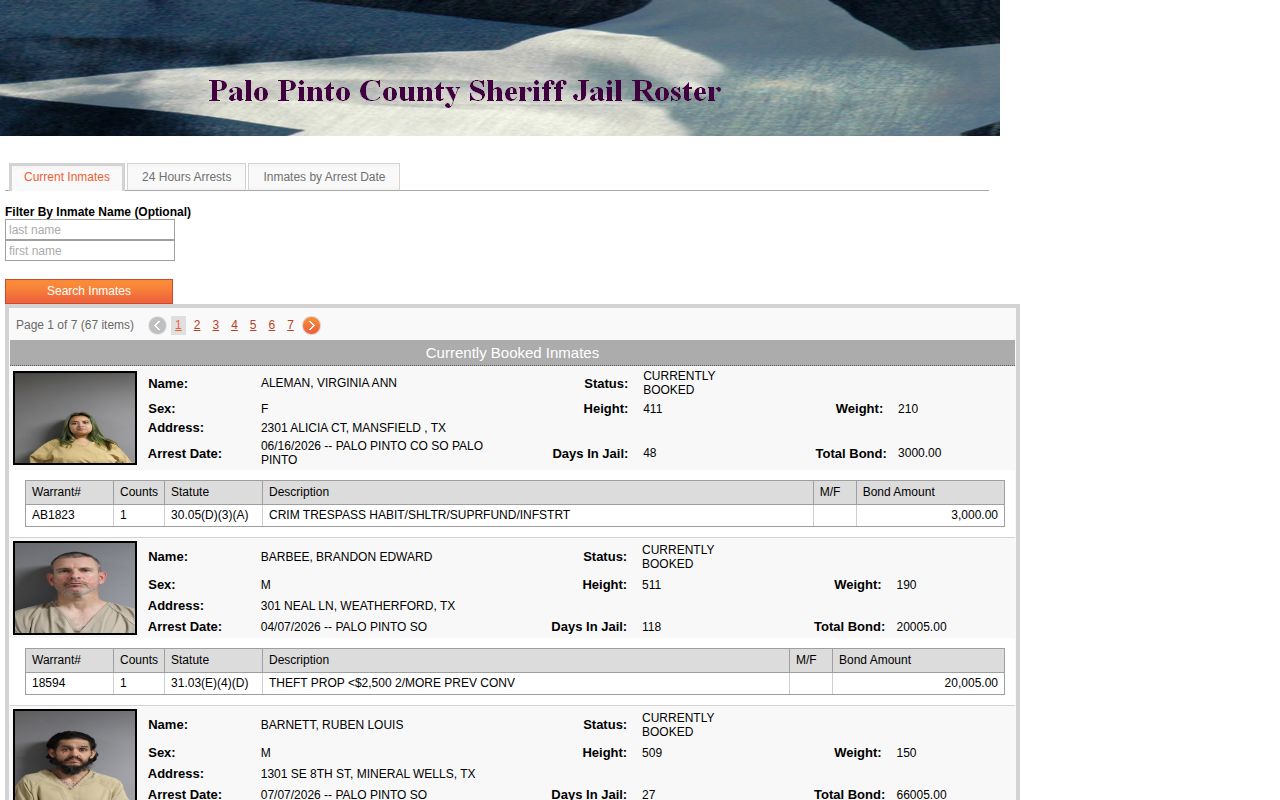
The screenshot shows why a visible photo should be saved only as a lead to the correct booking. Its presence does not prove continued custody, while its later absence does not prove release or erase the underlying agency record.
Use the name spelling, arrest date, charge, warrant number, and case number to resolve identity. An address on a card may be stale and should not serve as the main matching key. When two people have similar names, ask for the specific booking rather than a broad set of photographs.
Request a Palo Pinto Mugshot
The Palo Pinto County Sheriff Public Information Request makes the local route unusually clear because Mugshot is a predefined request type. The form asks for requester contact details, the involved location, the involved person's name, and a specific incident date. A case or service number and added detail can narrow the search.
- Confirm the booking agency and approximate arrest date.
- Select Mugshot on the official sheriff form.
- Give the full booked name and a booking, warrant, or cause number when known.
- Ask for the existing booking photograph tied to that one event and prefer electronic delivery.
- Accept lawful redaction and keep the agency response with the image.
The form publishes no local fee or fixed response time. Under the Texas Public Information Act, public records must be produced promptly or handled through the applicable withholding and notice process. A ten-business-day Attorney General ruling deadline is not a universal delivery promise.
The official request screen displays Mugshot beside the other report choices and shows the identifying fields needed for a focused request.
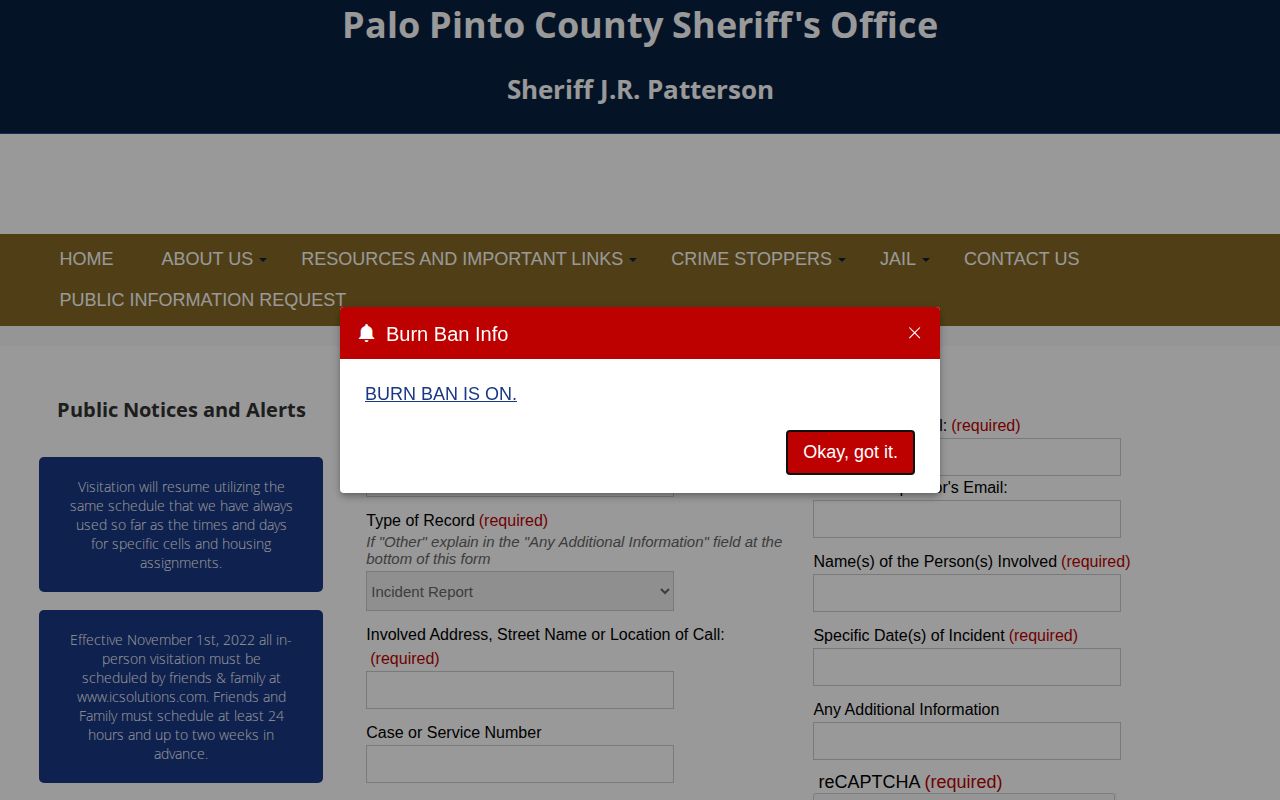
The separate Mugshot choice is the strongest route after a released person's current roster card is gone.
Palo Pinto State Photo Route
A person transferred from Palo Pinto County Jail to TDCJ remains in custody, and the county mugshot is not the same record as a TDCJ-CID photograph. TDCJ policy identifies the CID photograph as information that may be available through a formal public-information request, subject to law. The ordinary email inmate-information service expressly does not provide photos.
Request the TDCJ image only for a state-prison record. Provide the full name and seven-digit TDCJ number when known, or enough identity data to distinguish the person. A no-result on the public offender search does not establish that no historical state record or image exists. Older release and discharge material may require a focused formal request.
- Booking photo
- An image tied to a local arrest and booking.
- CID photograph
- A TDCJ correctional identification image held in the state record.
- Registry photo
- An image displayed only for a person subject to a legal registration duty.
Palo Pinto Mugshot Publication Law
Texas Business & Commerce Code Chapter 109 treats arrest photographs as criminal-record information for covered commercial publication. It creates accuracy, completeness, correction, and removal rules in defined circumstances, including rules tied to expunction and nondisclosure. Those duties are separate from a sheriff's obligations under the Public Information Act.
The official Chapter 109 text is the source for those commercial-publication rules.
The statute does not create a blanket promise that every official or news image must be removed on demand. The record's source and legal status control the next step.
No Palo Pinto Mugshot App
No official Palo Pinto sheriff mobile app or recent-release social feed was linked in the sheriff ecosystem reviewed. That finding is limited to official linked sources. It does not endorse or validate any third-party store listing. The verified online channel is the web roster for a current photo, followed by the sheriff's request form for an older image.
Local news may carry an arrest image tied to a public event, but a story is not a release record and may never reflect the later court result. A commercial mirror can be stale, incomplete, or matched to the wrong person. Neither should displace the originating sheriff, TDCJ, court, or registry record.
Expunction under Texas Code of Criminal Procedure Chapter 55A and nondisclosure under Government Code Chapter 411 are distinct access limits. Release by itself does not erase an arrest image. When a valid order applies, use the order with the agency or publisher responsible for the record and do not preserve an older copy merely because it remains elsewhere.
Match Palo Pinto Mugshot Identity
Name-only photo matching is weak. Start with the spelling used by the booking agency, then compare middle name or initial, suffix, date of birth or age, sex, arrest date, charge, booking number, warrant number, and court cause number. When the record involves TDCJ, use the SID or TDCJ number. A face resemblance is not an identifier and should not bridge two systems by itself.
Dates need exact labels as well. An arrest date identifies the event connected to a county mugshot. It is not a release date. A court order may explain the legal outcome but may predate or follow physical departure. A later TDCJ photograph belongs to the state correctional record. Keeping those labels intact prevents an old image from being presented as a current custody photo.
If official sources conflict, ask the source agency to correct or explain its own record. The sheriff controls the county booking image. TDCJ controls its CID photograph. DPS controls the public registry display. The clerk controls signed case documents. Note when each record was obtained and do not choose a result merely because it appears newest or most favorable.
Palo Pinto Mugshot Access Limits
Release does not automatically clear an arrest record. Texas expunction and nondisclosure depend on the case facts and a valid legal process. Expunction under Chapter 55A can restrict maintenance, release, and use of qualifying records. Nondisclosure is different: it limits ordinary public disclosure for qualifying criminal-history information but does not destroy every record and permits access by listed agencies.
Juvenile records are confidential, and the Palo Pinto County Clerk states that juvenile records are not public. Victim-identifying details and other protected fields can also be withheld. A photograph request should accept lawful redaction and stay tied to one known booking. Broad requests risk gathering unrelated confidential material and make accurate identity resolution harder.
A court outcome and a booking image answer different questions. An acquittal or dismissal may change the case status, yet the photograph still documents that an arrest record once existed unless a legal access restriction applies. Conversely, an online image cannot prove the charge survived, a conviction followed, or the person remains in custody. Obtain the signed disposition when the outcome matters.