
Palo Pinto 72-Hour Release Check
Palo Pinto County has no official list of people released during the prior three days. The sheriff links to the Interop jail interface, but its choices are Current Inmates, 24 Hours Arrests, and Inmates by Arrest Date. None offers a 72-hour release window. Arrest-date searching can help identify bookings within a chosen range, yet it cannot show which of those bookings ended in release.
The distinction matters most when a name has just vanished. Removal may follow bond release, a court order, time served, transfer, a data correction, or system lag. A release order can also arrive before jail staff finish processing other holds. The sheriff's booking-out entry and release or transfer order are the durable sources for the completed event.
Rebuild Palo Pinto Three-Day Releases
A sound three-day review sets an exact beginning and end, then tests each known booking. Do not treat “the last 72 hours” as a county filter because none exists. Use the arrest-date view to locate relevant intake events, the current roster to test present visibility, and durable records to learn how each booking ended. Keep the person's full name and identifiers with every date.
- Search Current Inmates. If the correct person is still shown, the released-person question is premature.
- Use Inmates by Arrest Date to find booking context within the chosen three-day span. Record each exact arrest date and identifier.
- Check the relevant county or district court case for a signed bond, dismissal, judgment, or release order. A docket date alone is only a schedule.
- Submit the sheriff's public-information form. Request the booking-in/out sheet, exact release or transfer time, release type, authority, and destination.
- If transfer is possible, search TDCJ or the correct federal or immigration system before calling the event a release.
The named-person route is covered on the Palo Pinto County released inmates home page. A three-day reconstruction asks which known bookings ended during a bounded interval. The home search instead follows one identity across county, state, and federal systems.
Palo Pinto 72-Hour Fields
The online cards contain arrest and current-custody facts, not the fields of a three-day release feed. This comparison shows which facts can help define the interval and which must come from a retained sheriff record.
| Field | Where and what it shows |
|---|---|
| Name, sex, address | Shown on the current card for identity context; not release evidence. |
| Arrest date | Shown online; marks intake activity, not the end of custody. |
| Total bond and charge bonds | Shown online as conditions or amounts; not proof that a bond was posted and accepted. |
| Charge, level, statute, warrant | Shown in the charge table and useful for matching the court case. |
| Release date, time, and type | Not shown online; request the sheriff's booking-out or release record. |
| Transfer destination or authority | Not shown online; request the transfer order and verify with the receiving system. |
Texas retention rules give the offline route lasting value. The permanent jail register includes a release or transfer date. Booking-in/out sheets and commitment, transfer, and release orders have a minimum retention of two years after departure, though access can still be limited by law and actual local retention may be longer.
The official Interop screen shows the exact tabs and fields that create this common search trap.
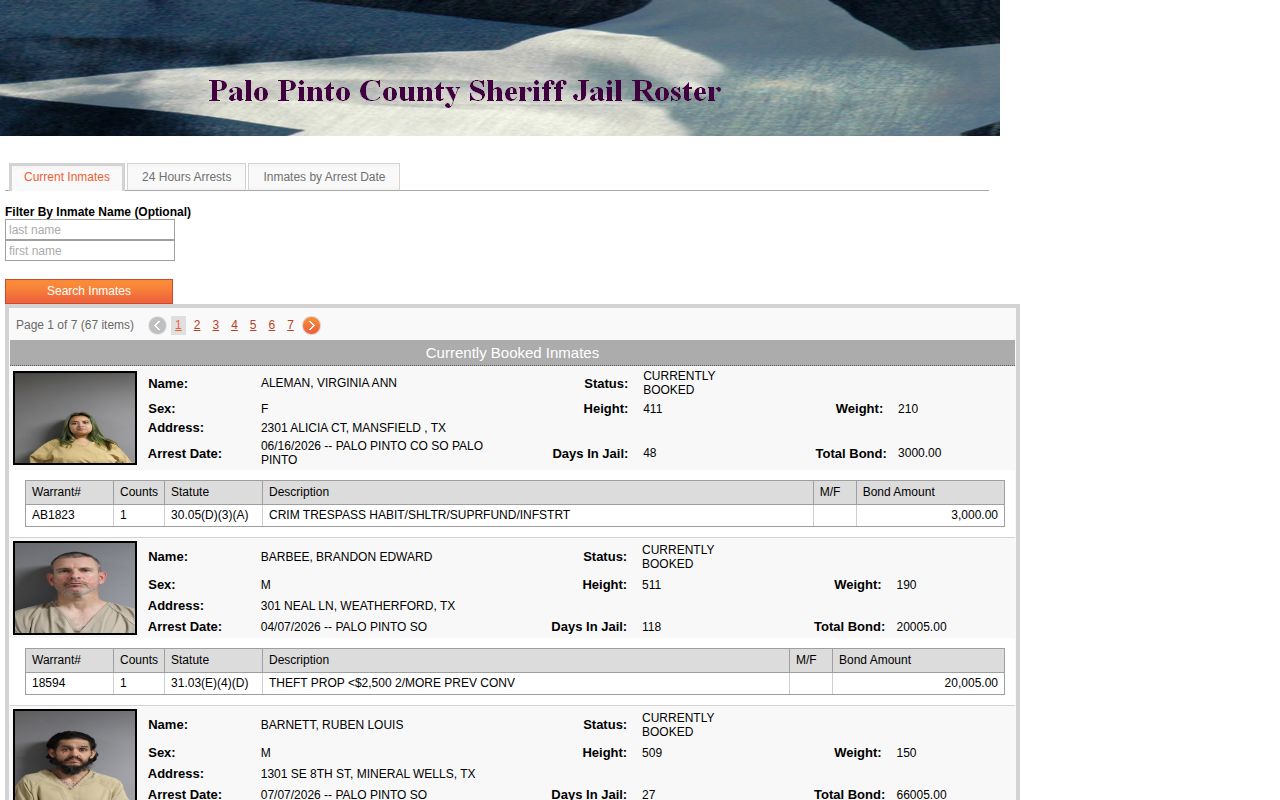
The screenshot confirms that the 24-hour option is arrest-focused and supplies no release date, release reason, or released status.
Request Palo Pinto Three-Day Records
The Palo Pinto County Sheriff Public Information Request is the direct fallback. Select Other for the release record. Identify the person, approximate booking date, involved location, and a case or service number if known. Ask for existing documents, not an explanation that staff would have to create.
Please provide booking-in/out sheets and release or transfer orders for the named person within the stated three-day range, including each recorded departure time, type, authority, and destination.
Electronic delivery and lawful redaction can be accepted. The form does not publish a local fee or fixed turnaround. Texas law calls for prompt production or the applicable notice and ruling process; the ten-business-day rule often discussed under the Public Information Act is not a promise that all documents arrive within ten days.
IVSS-Counties can provide prospective alerts if Palo Pinto participation is live, but it is not a historical list for a past weekend. For state-prison custody, use TDCJ information and seek actual release or discharge confirmation. The Palo Pinto same-day release check is the narrower route when only the most recent day matters.
Palo Pinto Release or Transfer
A county booking can end in several ways. Bond, personal recognizance, dismissal, time served, sentence completion, or another court-authorized act may return a person to the community. A transfer to TDCJ, another county, the U.S. Marshals Service, or ICE ends Palo Pinto County custody but does not end custody as a whole. Hospital movement, escape, death, an outage, or a data correction must also never be mislabeled as release.
- Release
- A documented end or change in custody under lawful authority.
- Transfer
- Movement from one custodian to another while custody continues.
- Booking-out record
- The jail record that marks processing out and may state the time and reason.
- Disposition
- The court's resolution or order in a case, which may explain authority but not the physical processing minute.
Match each fact to the office that created it. The sheriff proves the county booking-out event. The court proves its order or judgment. TDCJ proves state reception and state release. A past event can remain valid even if a later warrant or arrest returns the person to custody, so describe the timeline rather than forcing every source into one present-status label.
Palo Pinto Weekend Release Review
A three-day span often crosses a weekend, holiday, or both. Palo Pinto County publishes no rule promising a standard gate time, a weekend-release schedule, or a fixed web update cycle. It is therefore unsafe to assign a roster change to a particular day merely because the name was present on Friday and absent on Monday.
Build the timeline from labels in the records. A signed order date shows when a court acted. The booking-out time shows when jail processing ended. A transfer date identifies movement to another custodian. These can fall on different days. If a state-prison date is involved, TDCJ has its own weekend and holiday law, but that rule does not establish a Palo Pinto County Jail practice.
Palo Pinto Roster Retention
The Interop site states no update cadence and no period for keeping a person visible after departure. A Monday search cannot reliably reconstruct what appeared at each point during the weekend. Capture identifiers while they are visible, but treat screenshots as context rather than proof of release.
Texas retention rules supply the historical route. The permanent jail register includes the release or transfer date, while detailed booking-in/out sheets and release or transfer orders generally have a minimum two-year retention after departure. Those record series can answer a properly bounded 72-hour request long after the live web card changes.
Palo Pinto Three-Day Timeline
Build one row in the timeline for each official event rather than one row for each search. Begin with arrest and booking. Add the signed court action, the sheriff's booking-out or transfer time, and any reception record from a later custodian. If a new arrest follows, preserve the earlier release as a completed historical event and describe the return to custody separately.
Identity checks are vital across a three-day batch. Compare middle name or initial, suffix, date of birth or age, arrest date, charge, booking or warrant number, and court cause number. For a possible state transfer, SID or TDCJ number is stronger than a name. A broad name result without shared identifiers should remain unconfirmed.
The three-day view also catches different legal endings. A personal-recognizance order, accepted bond, dismissal, local sentence completion, and transfer may all remove a current card. Only the first four may result in community release, and even then another hold can continue custody. A TDCJ reception record after a felony judgment points to state confinement. A federal court or USMS record may show continued federal custody without a public jail locator. Use the destination system before assigning the word “released.”