
Palo Pinto Parole Versus Probation
Parole is a discretionary release from Texas Department of Criminal Justice custody. The person leaves prison but remains under the TDCJ Parole Division for the unserved part of the sentence. Mandatory supervision is another supervised state-prison release mechanism. Eligibility depends on the offense, its date, sentence credit, exclusions, and in some cases a Board decision. Neither status is the same as completing the sentence.
Probation is the common name for court-ordered community supervision. It is managed through the court and Palo Pinto County Community Supervision and Corrections Department, or CSCD. It can be ordered instead of imprisonment and may include a short county-jail condition. A probation order is not evidence that the person was released from TDCJ.
| Question | Parole or mandatory supervision | Probation |
|---|---|---|
| Who orders or authorizes it? | Texas Board of Pardons and Paroles under state law | The sentencing court |
| Who manages it? | TDCJ Parole Division | Palo Pinto County CSCD |
| Was there a prison release? | Yes, after TDCJ release processing | Not necessarily |
| Best public proof | TDCJ status, release record, and later discharge data | Signed supervision order and later discharge order |
Verify Palo Pinto Post-Release Supervision
Begin with the custody history. A person still listed in the Palo Pinto County Jail roster has not yet been shown as released from that jail. A person transferred to TDCJ has also not entered the community. For a state-prison case, the TDCJ Inmate Information Search can show current location, parole review data, projected release information, and later scheduled details when available. Match the TDCJ number or SID, birth date, conviction county, and offense before relying on a result.
- Identify whether the sentence came from a county court or involved TDCJ imprisonment.
- For a TDCJ case, search by TDCJ number or SID, then compare identity and conviction details.
- Read the exact status label, last parole decision, decision date, and next review month.
- For probation, obtain the signed judgment and community-supervision order from the correct Palo Pinto court.
- Use an actual release entry or discharge order to confirm the event, not a roster disappearance or expected date.
If the web search is inconclusive, call TDCJ pre-vote parole status at 844-512-0461. After approval, Review and Release Processing at 512-406-5202 is the relevant state channel. TDCJ also accepts identity-based information requests at its inmate-information email route. The broader Palo Pinto County released inmate search explains how to pair state results with county jail and court records.
Palo Pinto Parole Review Records
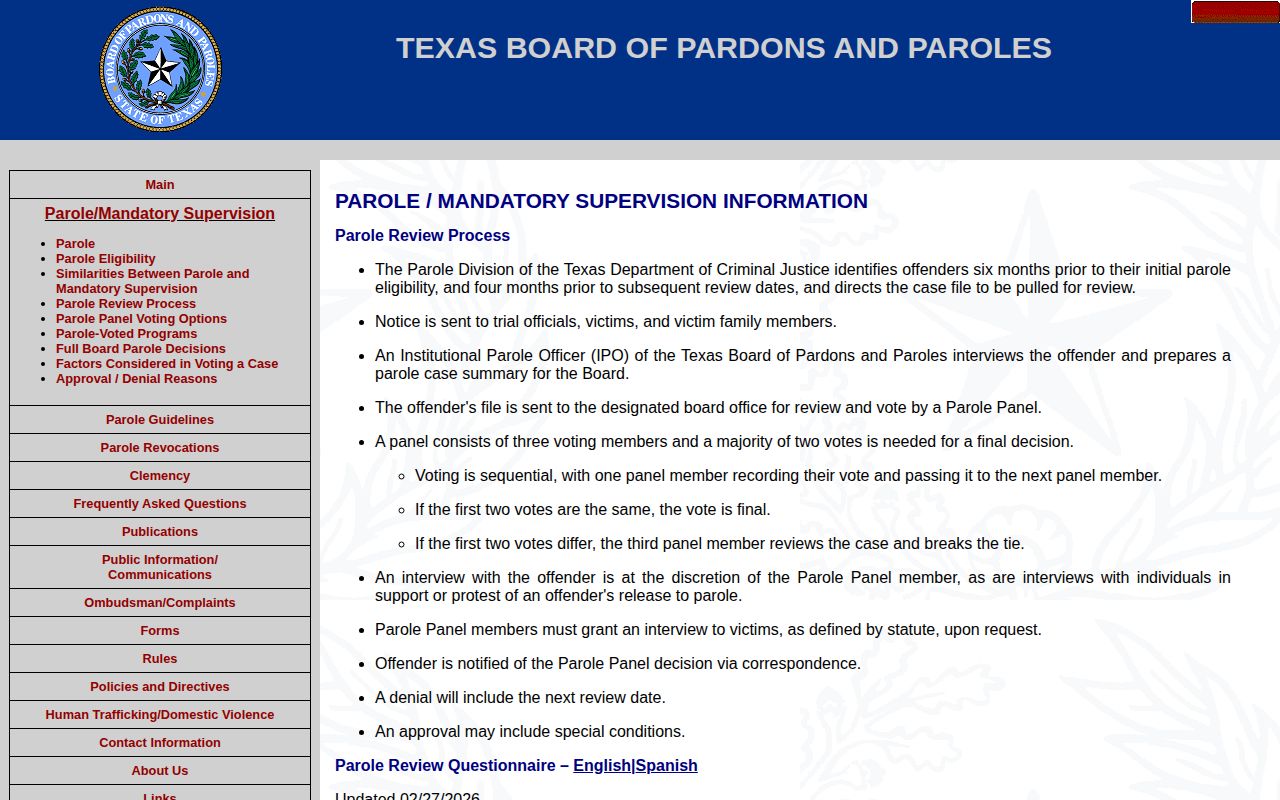
Texas does not hold an ordinary formal public parole hearing for each individual. An Institutional Parole Officer prepares a file summary, and three panel members vote in sequence. Two matching votes produce the result. TDCJ identifies an initial case about six months before the first eligibility date and a later review about four months before its next review date. These are review time frames, not promised release dates.
The official Board review explanation shows how the file review and vote sequence work.
An FI-1 result generally authorizes release when eligible. Other favorable FI codes may require a program, future date, residence plan, or added processing. A denial may state a next review date or require service of more time. Always preserve the exact code. Approval is a decision step, not an actual release record.
Palo Pinto Supervision Offices
People released on parole or mandatory supervision and assigned locally are served by the Mineral Wells District Parole Office, Region II. It is at 999 Cross Post Road, Mineral Wells, TX 76068. The phone is 940-325-7811 and fax is 940-325-9732. This district office handles community supervision. It should not be confused with the Mineral Wells Institutional Parole Office at 759 Heintzelman Road, which performs institutional and pre-release work.
Local supervision contacts
Mineral Wells District Parole Office
999 Cross Post Road
Mineral Wells, TX 76068
940-325-7811
Palo Pinto County CSCD
503 Oak Street
Palo Pinto, TX 76484-0099
940-659-1280
County probation is administered through Palo Pinto County CSCD. Texas has no public statewide probationer-name locator like the TDCJ offender search, and the county CSCD does not publish a client roster. The office can provide only status information it may lawfully disclose. The court’s signed order remains the durable source.
Palo Pinto Probation Record Proof
A court judgment and community-supervision order establish probation. Read them together. The judgment identifies the cause, disposition, sentence, and court. The supervision order states the term and legal conditions. A later signed discharge order establishes successful or other formal completion. A jail roster cannot prove probation completion because probation is not jail custody.
The official Palo Pinto County CSCD page identifies the local department.
Do not treat a court docket as the final order. A docket may show that a hearing occurred without stating the full ruling. For a felony, locate the district cause and request the signed judgment or discharge. For a county-level case, use the County Clerk’s available access paths and request by cause number where needed.
Palo Pinto Parole Warrants
A parole absconder is someone who stopped reporting and whose whereabouts are unknown. TDCJ provides a 24-hour anonymous tip line at 866-680-6667, but its absconder page is not a public name-search tool. A parole warrant may follow a new charge, indictment, failure to report, or another administrative violation. The warrant does not prove that the person is held in Palo Pinto County Jail.
Possible outcomes include continued supervision, changed conditions, an intermediate sanction or treatment placement, and return to TDCJ. A later arrest does not erase the earlier release. The accurate account is a timeline: actual prison release, supervised status, alleged violation or warrant, and any return to custody. County IVSS and TDCJ IVSS may send offered status alerts, but neither replaces the warrant, revocation decision, or custody record.
Palo Pinto Release ID Process
Palo Pinto County jail pages describe current-inmate mail, items, and commissary, but they do not publish release-exit or property-return instructions. A county property receipt may be retained for at least two years after release or transfer under the statewide public-safety schedule. Anyone trying to document returned property should ask the sheriff for the existing receipt rather than assume a public exit checklist applies.
State prison release works differently. Texas Government Code §501.0165 creates a TDCJ process to determine whether a person has a valid driver license or identification card and, where applicable, request a DPS identification card before release. That state process should not be described as a Palo Pinto County Jail service. The distinction matters when a person moves from the county jail to TDCJ because the county departure is a transfer, while the later TDCJ event may be a release into supervision.
Palo Pinto Supervision Discharge
Supervision ends through a formal discharge, not simply because an online search stops returning a name. For parole or mandatory supervision, TDCJ records distinguish release into supervision from final discharge at the end of the state sentence. Government Code Chapter 508 governs parole and mandatory-supervision eligibility and administration. A projected date, scheduled date, Board vote, and actual discharge are separate events.
For probation, obtain the court’s discharge order. CSCD may provide appropriate administrative confirmation, but the judicial order is the lasting case record. If sources conflict, use the agency responsible for the event: the court for probation orders, TDCJ for state release and discharge, and the sheriff for county booking-out. Keep each source’s exact date label so a decision date is never shortened into a release date.